
This Week in Markets - July 26: The Fed Meets, and deep in Tech Earnings
Oil above $95, a 10-year yield at levels last seen before this administration took office, and four of the five biggest companies in the market reporting into a live FOMC decision.

Welcome back to another weekly market prep with The Dividend Journal! If this is your first time here, great timing. This newsletter is your one stop shop to stay ahead of the market and step into the week fully prepared.
Two things broke at once last week: The AI capex trade cracked when Alphabet told the market it would spend $205 billion this year, and the Middle East escalated to the point where Brent briefly touched triple digits. The result was a second straight losing week for all four major indexes, with the Nasdaq taking the worst of it, and a rates market that suddenly stopped pricing cuts and started pricing hikes.
That sets us up for a huge week of catalysts: Wednesday is Kevin Warsh’s third FOMC decision as chair and tech earnings.
Let’s get into it.
⚡ Last Week Overview
Every major index lost ground, with the bulk of the damage in tech. There’s a 175 basis point gap between the Dow and the Nasdaq in one week, showing a clear rotation out of long duration growth.
Alphabet broke the AI trade by beating on everything that matters. $GOOGL posted revenue of $119.8 billion, up 24%, EPS of $9.11, and Google Cloud growth of 82%, and the stock still fell roughly 5% after raising 2026 capex guidance to $195 billion to $205 billion against a Street estimate near $188 billion. Q2 capex alone was $44.9 billion, double last year. The Magnificent Seven shed nearly $800 billion in market value on Thursday. The market has stopped paying up for AI spending and started asking when it earns a return.
Oil went vertical on Iran, and the bond market noticed. Brent settled Thursday at $97.87 and traded above $100 intraday after Iran backed Houthi forces struck two Saudi tankers in the Red Sea, on top of ongoing disruption at the Strait of Hormuz. The 10-year Treasury yield topped 4.7%, the highest since January 15, 2025. Friday brought relief: WTI fell 4.3% to $88.25 and the 10-year settled back to 4.67%.
New tariffs landed Friday with almost no market reaction. Duties of 10% to 12.5% took effect at 12:01 a.m. ET on 60 trading partners covering 99.4% of US imports, imposed under Section 301 after the Supreme Court struck down the prior reciprocal regime in February. Bitcoin finished around $64,000, still up about 3% on the week despite the Friday fade.
🃏 The Wild Card: Does Warsh signal that the next move is a hike?
The funds rate sits at 3.50% to 3.75%, and essentially nobody expects that to change Wednesday. Markets put the odds of a hold at roughly 80%. Fed funds futures now imply about an 82% chance of a hike by September, up from under 53% a week ago, driven almost entirely by oil. The June minutes already showed nine of eighteen policymakers seeing a case for at least one increase before year end, and Chair Kevin Warsh, confirmed in May by a 54-45 Senate vote, has said plainly that prices are too high. This is a non-SEP meeting, so there is no dot plot to hide behind. The statement language and the 2:30 p.m. press conference will be the primary focus followed by June PCE and Q2 GDP less than 24 hours later.
The constructive path runs through the distinction between a supply shock and a demand problem. Core PCE last printed at 3.4% year over year for May, the highest since October 2023, but the acceleration is heavily energy driven, and Friday’s 4.3% drop in WTI is a reminder that geopolitical premium can leave as fast as it arrives. If Warsh frames the oil move as a relative price change the Fed should look through, holds the statement close to June’s language, and Thursday’s core PCE comes in near consensus, the September hike pricing unwinds quickly and the rates headwind on equities lifts.
The tail to respect is a hawkish hold that lands on top of a hot PCE print. If Warsh explicitly opens the door to September and core PCE surprises to the upside on Thursday, the market has to reprice a hiking cycle it spent the entire first half assuming was over, and it has to do that while the four largest companies in the index report capex plans the market has already decided it hates.
🗓️ The Week, Day by Day
Tuesday, July 28: FOMC day one, Conference Board consumer confidence for July at 10:00 a.m. ET, and a heavy earnings slate: BA 0.00%↑ , V 0.00%↑ , KO 0.00%↑ , F 0.00%↑ , PYPL 0.00%↑ , and UPS 0.00%↑ .
Wednesday, July 29: The main event. FOMC statement at 2:00 p.m. ET, Warsh press conference at 2:30 p.m. ET, then MSFT 0.00%↑ , META 0.00%↑ , QCOM 0.00%↑ , ARM 0.00%↑ , and SBUX 0.00%↑ after the close.
On earnings, capex guidance is the only line that matters after what Alphabet did. Microsoft is guiding to roughly $190 billion and Meta to $125 billion to $145 billion for 2026, and the market’s reaction function has flipped: bigger is no longer better.
Thursday, July 30: Q2 GDP advance estimate and June PCE, both at 8:30 a.m. ET, then AAPL 0.00%↑ , AMZN 0.00%↑ and COIN 0.00%↑ after the close. This is the densest day of the quarter. Atlanta Fed GDPNow last had Q2 tracking at 1.7%, which would be a clear slowdown, and core PCE is the number that validates or destroys the September hike trade.
Apple is the one mega cap that is not a capex story so it’ll be interesting to see how the market reacts to this one.
Friday, July 31: Q2 Employment Cost Index at 8:30 a.m. ET, final July University of Michigan sentiment and inflation expectations at 10:00 a.m. ET, and XOM 0.00%↑ plus CVX 0.00%↑ . No market holiday.
📈 Market Update
The market continues to print a divergence and is reflected through the $SPY’s strength vs $QQQ. We are still clinging onto the daily 50EMA, which is largely supported by the Dow’s strength.
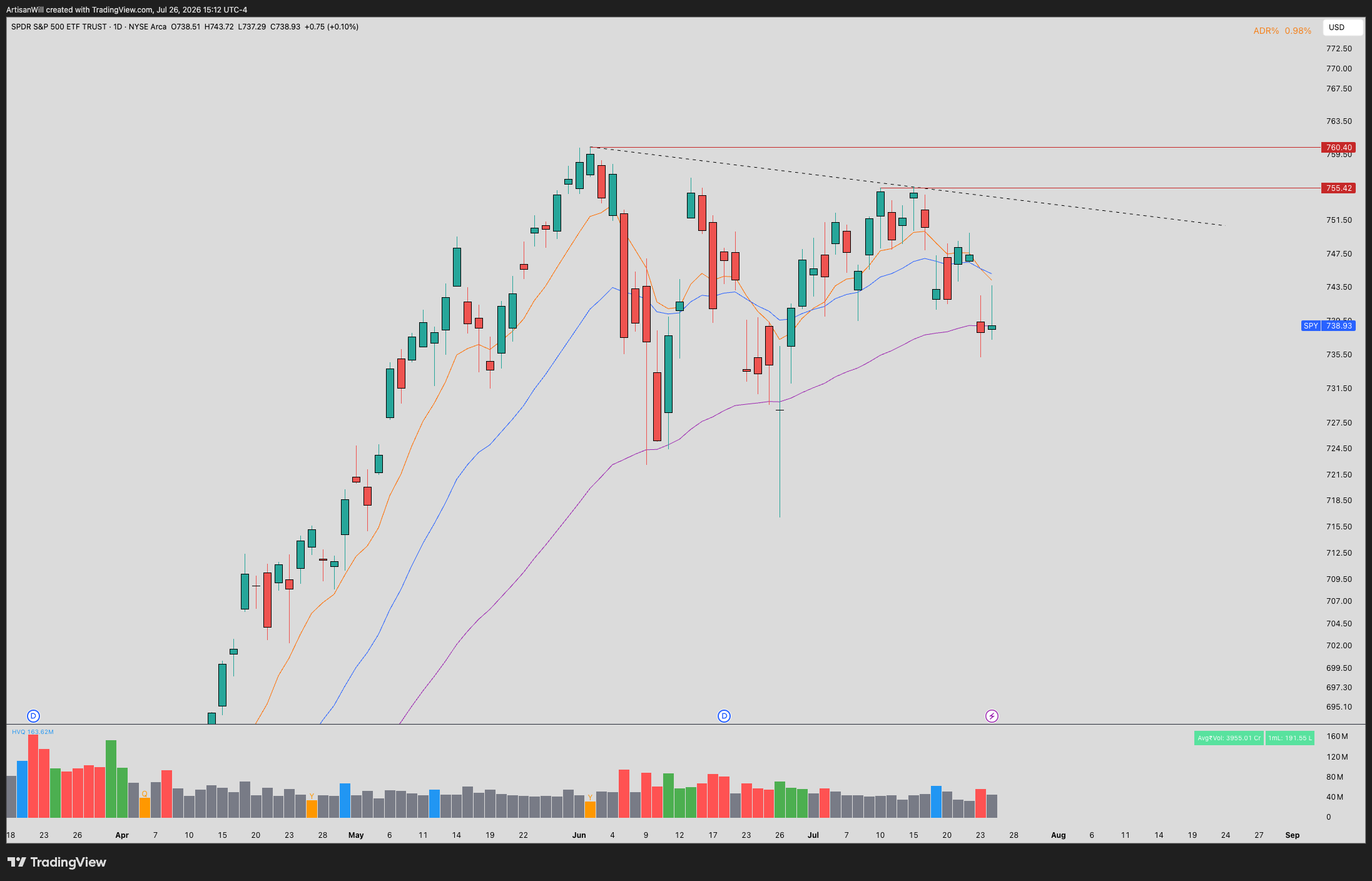
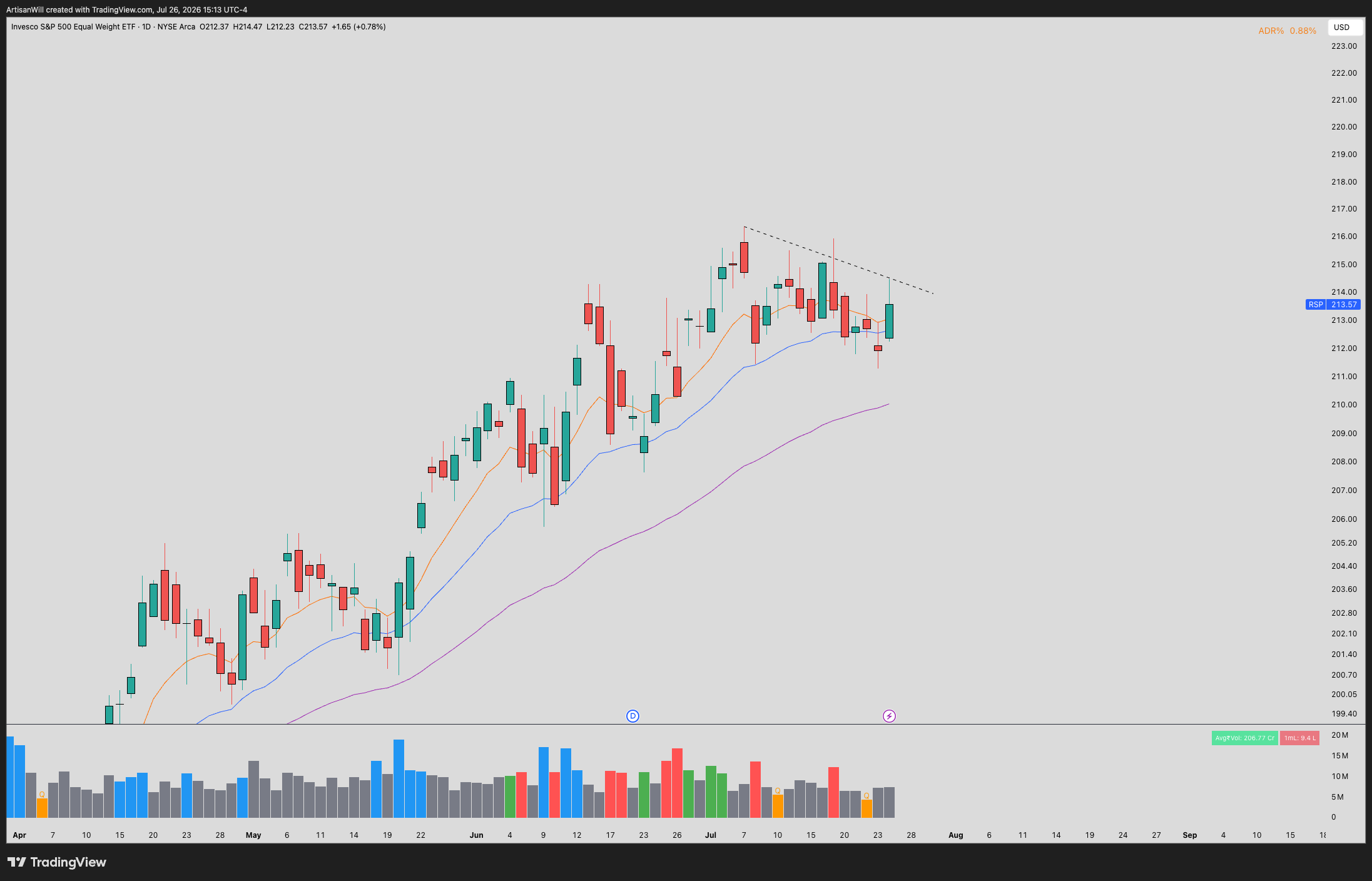
When compared to RSP 0.00%↑, you can easily tell that this is a very harsh rotation/profit taking situation out of a lot of the tech companies that have been spending massively on capex or have ran up a lot.
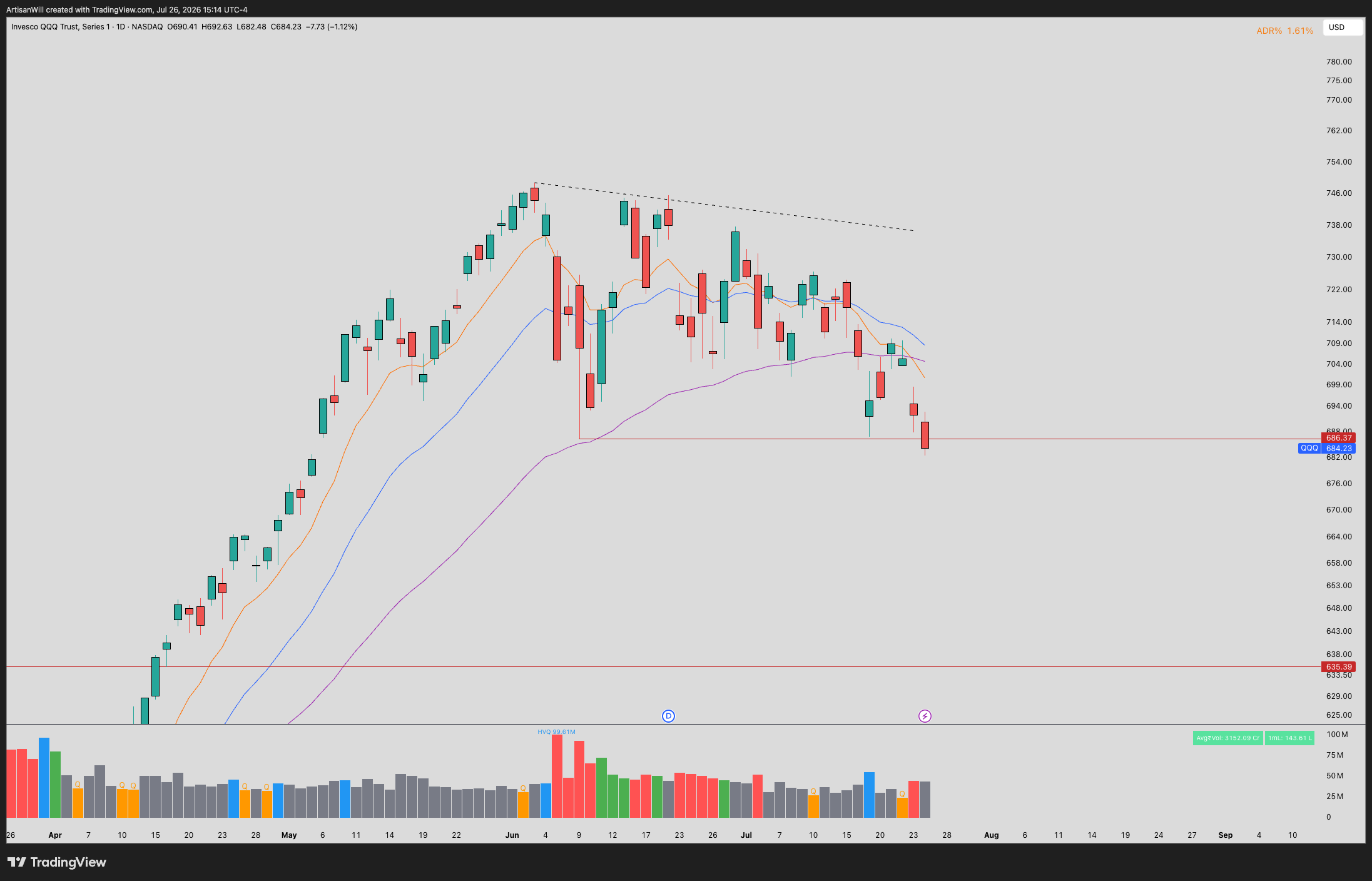
This thesis is further supported by tech’s prominent weakness and breaking under the June 9th low as of Friday close.
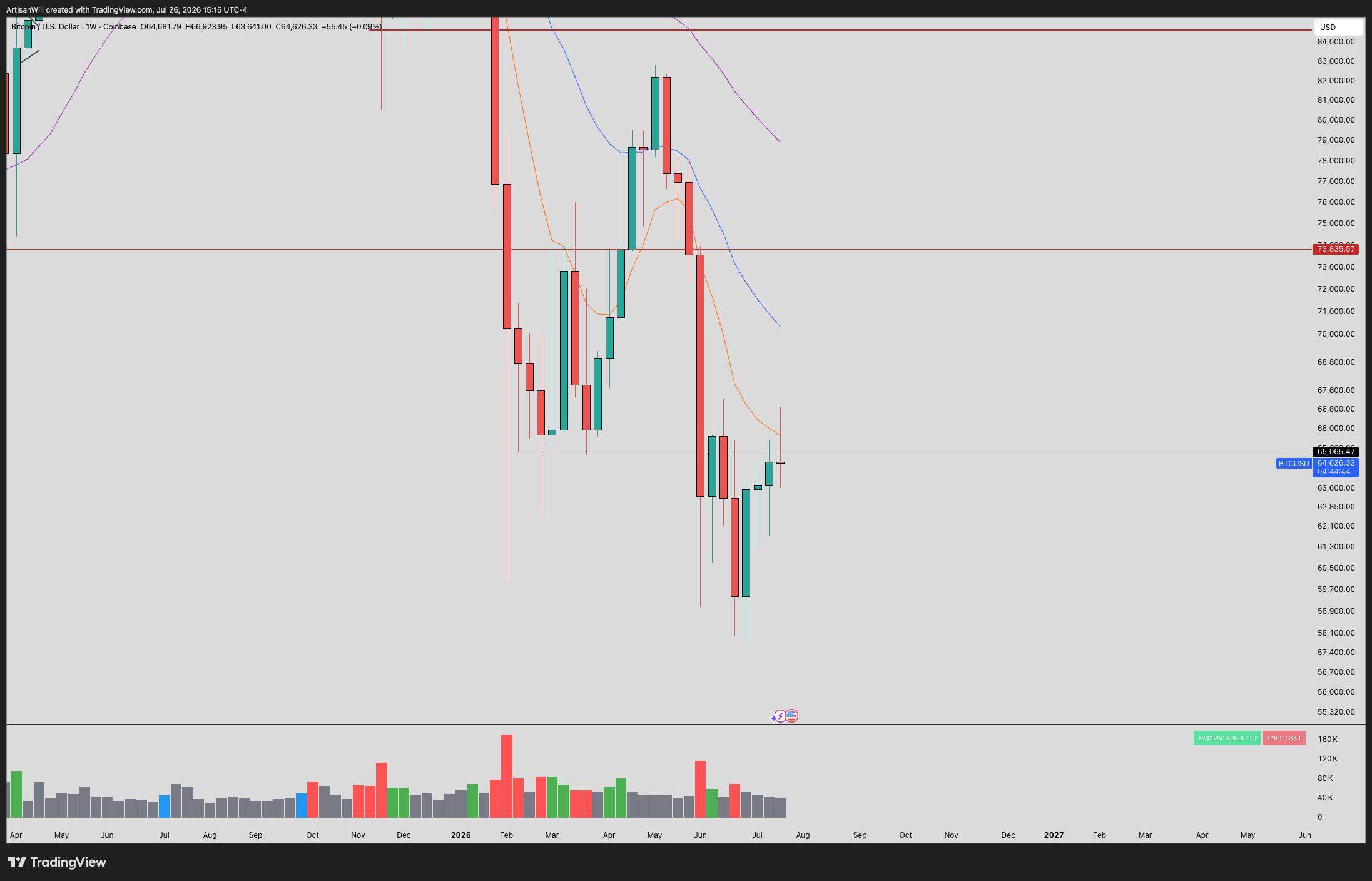
Meanwhile, Bitcoin continues to fight at this 65k level and looks to be establishing a bottom near here. The rotation from tech into crypto is a healthy sign of a rotation and nothing else. Like any market cycle, we will get moments of chop and consolidation while individual names get rotated in and out of.
🔍 What I’m Watching
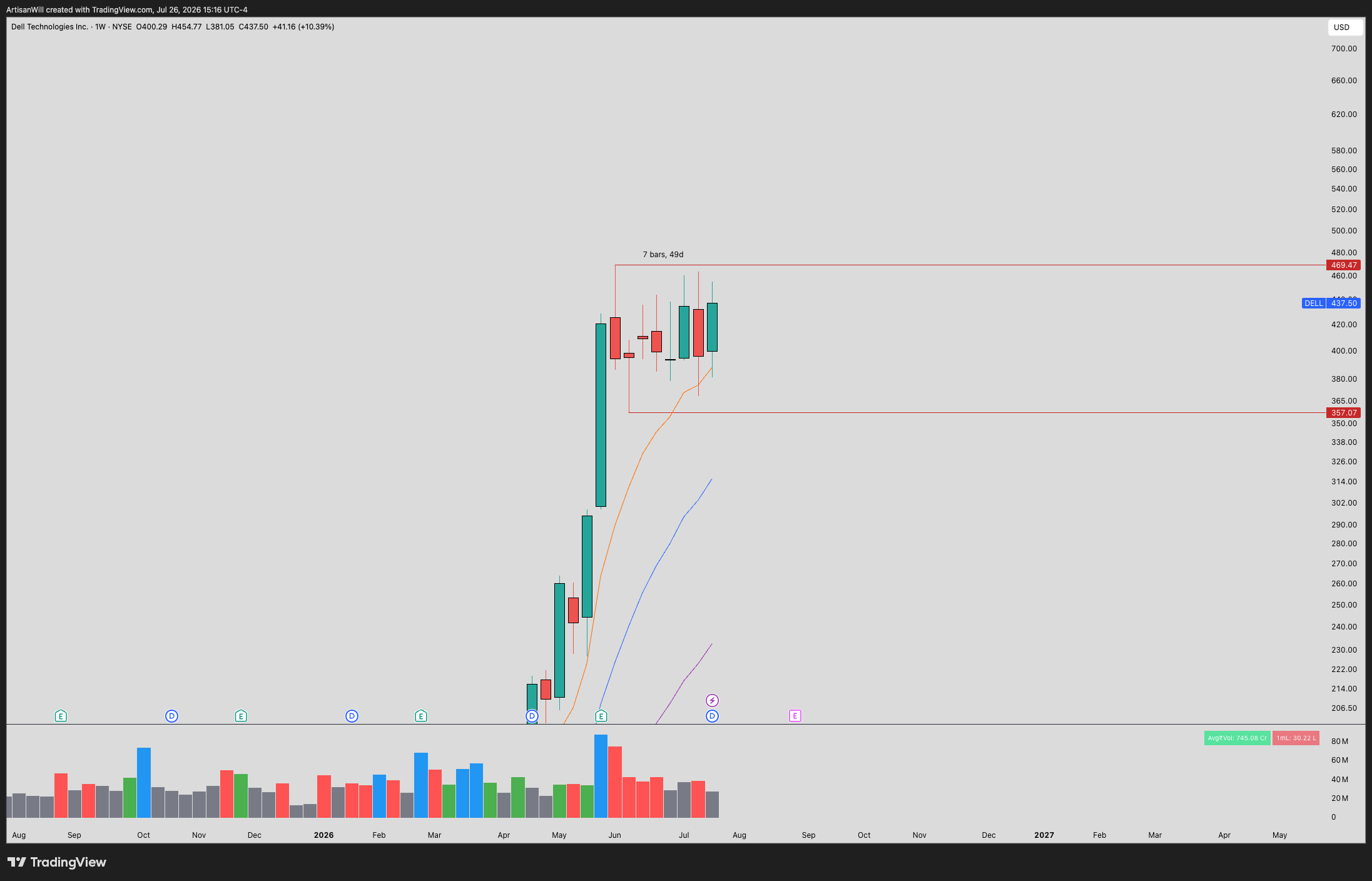
DELL 0.00%↑: close to two months of digestion with a lot of potential earning catalysts this upcoming week
Over $470 is key, and biggest focus is weekly structure since the daily is a bit messier
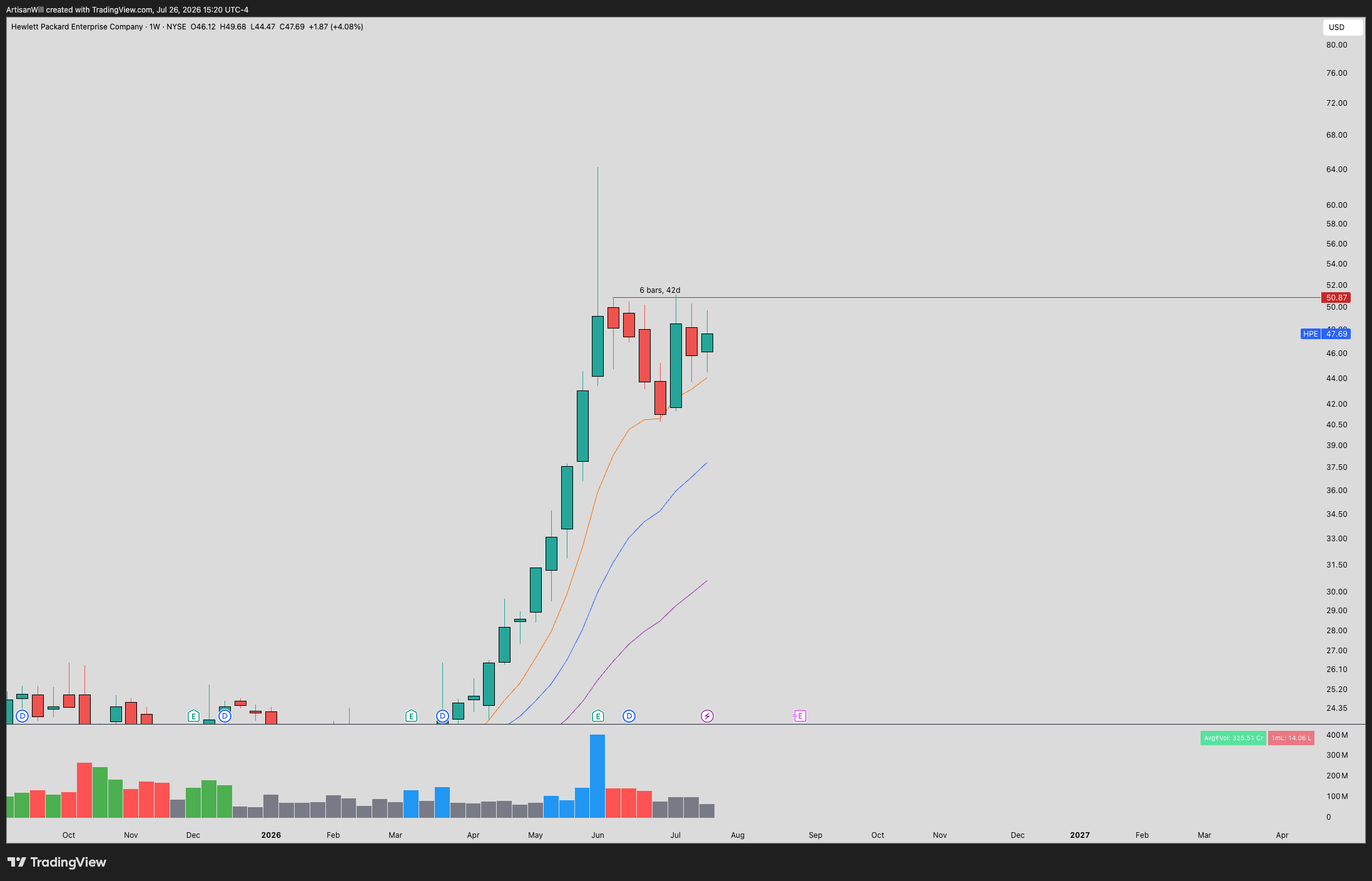
HPE 0.00%↑: very similar look to DELL 0.00%↑ with a large weekly consolidation period
Over $51 is key and a weekly close above this heavy sell zone
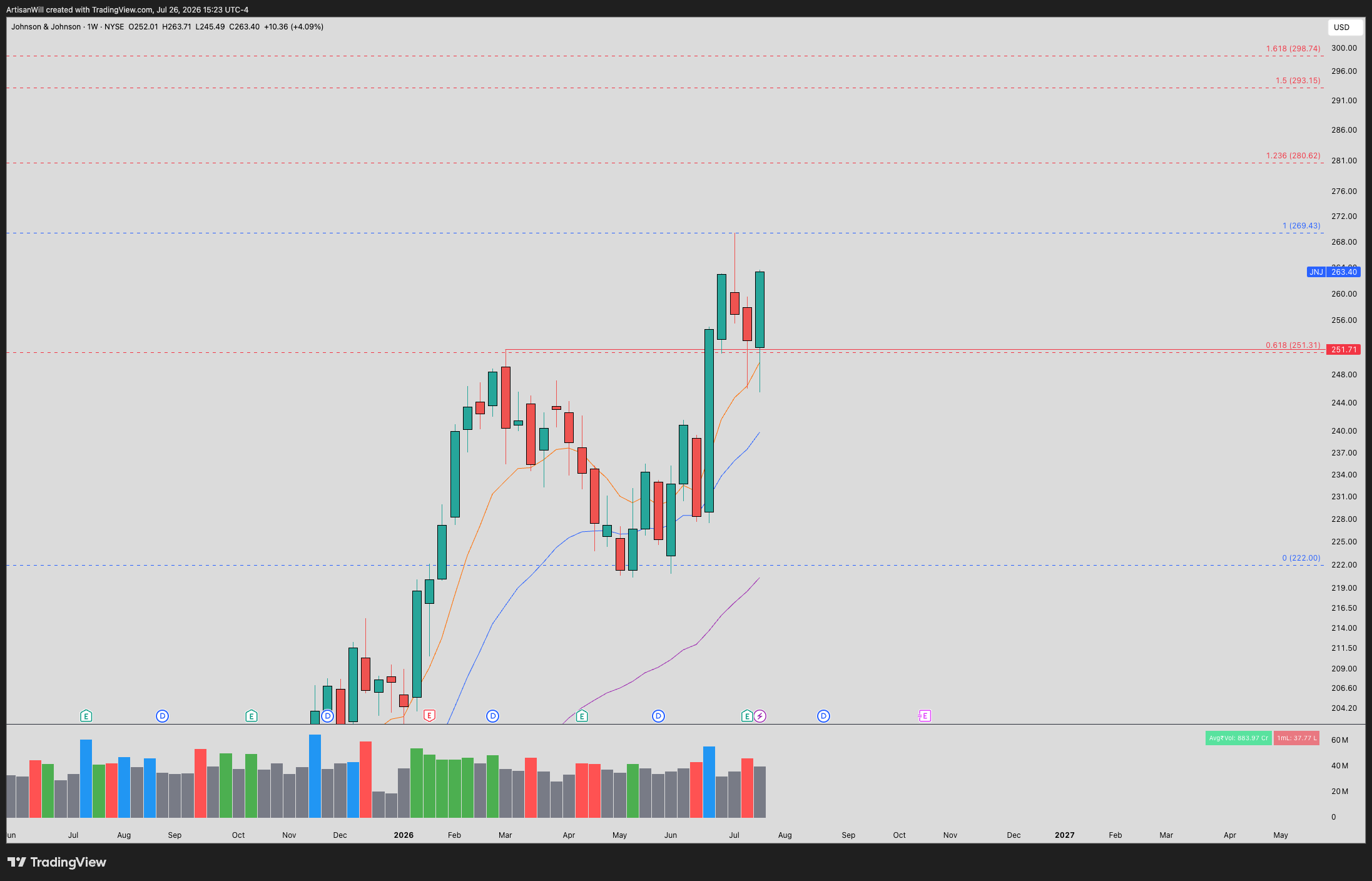
JNJ 0.00%↑: huge weekly hammer off the previous ATH pivot with other healthcare ERs coming up
XLV 0.00%↑ also shaping up wanting higher, and JNJ 0.00%↑ can be a great sympathy play as 2nd heaviest weighting
💡 My Take
The rotation underneath the indexes is the more actionable signal. A 175 basis point weekly gap between the Dow and the Nasdaq, with small caps also lagging, tells you money is leaving long duration growth and it is not simply going to cash.
The warning signs are that the relative strength names are no longer the high growth companies anymore. It’s in defensive names like Oil, healthcare and consumerable names.
Let the Fed speak, let the mega caps report, let PCE print, and take the trade Thursday afternoon with actual information instead of Tuesday with a guess. The setups will still be there. The specific thing I do not want to do is chase an oil driven inflation narrative that could reverse on a single headline out of the Strait of Hormuz, in either direction.
Work with me 1-on-1: I keep a few private spots for traders who want direct help with their process. Details here.
See you next week. Trade well.
Will