
This Week in Markets - July 19: The AI Trade Gets Asked for Receipts
Chips just fell into a bear market, and on Wednesday night the two companies writing the biggest checks have to explain themselves.

Welcome back to another weekly market prep with The Dividend Journal! If this is your first time here, great timing. This newsletter is your one stop shop to stay ahead of the market and step into the week fully prepared.
Last week broke a two week win streak, and it broke it in a specific place. The S&P 500 lost 1.6% while the Nasdaq gave up 2.9%, but the real damage was concentrated in semiconductors, where a Chinese model release reopened the question nobody wanted to answer: what if frontier AI gets cheap? Meanwhile oil ripped higher on escalating US and Iran hostilities, and Treasuries barely moved.
So we walk into a week where the tape has already decided it is nervous, and the calendar hands it Alphabet and Tesla on Wednesday, Intel on Thursday, and a Fed decision waiting just past the weekend.
Let’s get into it.
⚡ Last Week Overview
The selling was narrow, not broad. The S&P closed down 1.6% on the week and the Dow fell 406.55 points Friday but the Russell 2000 closed just -0.5% on the week. Small caps barely flinched. This was a megacap tech problem, not a market problem, and Netflix made the point by falling roughly 8% Friday after guiding Q3 revenue to $12.9 billion against $13.0 billion consensus. (Barchart, Yahoo Finance, CNBC)
Semiconductors fell into a bear market. The Philadelphia Semiconductor Index dropped roughly 11% on the week, its worst since March 2025, putting it more than 20% below its late June record. Context matters here: that index had run 105% from its March low to that peak. Applied Materials fell 5.6% Friday, Nvidia fell 2.2% and briefly lost the world’s most valuable company title to Apple. (Bloomberg)
Oil was the week’s biggest mover, due to geopolitical tension. Brent surged 4.6% Friday to $88.10 and WTI gained 4.5% to $82.49, capping a week up more than 14%, after Kuwait said Iran struck a power and water desalination plant. Iran said it hit US targets across Bahrain, Jordan, Kuwait, Oman, Qatar and Syria. The Strait of Hormuz carries roughly 20% of global seaborne oil, which is why this repriced so violently. (CNBC, Al Jazeera)
The best inflation news in six years got upstaged. June CPI fell 0.4%, the first monthly decline in more than six years, pulling annual inflation down to 3.5% from 4.2%, with core flat on the month. PPI came in cool too. But new Fed chair Kevin Warsh spent his first congressional testimony refusing to take the win, telling lawmakers the improvement “isn’t mission accomplished,” and September hike odds only eased to about 60% from 75%. The 10 year finished flat at 4.55% as the soft data and the oil shock canceled each other out, while Bitcoin slipped under $63,000 after failing twice at $65,000, trading down with equities rather than as a hedge. (CNBC, CNN, Fortune)
🃏 The Wild Card: Does the AI capex story survive Wednesday night?
The market spent eighteen months paying up for a simple premise: frontier AI is expensive, compute is scarce, and whoever owns the compute owns the margin. Alphabet and Tesla both report after the close on Wednesday, July 22, followed by Intel on Thursday. Alphabet is one of the largest capex spenders in the world and Intel is the clearest read on whether chip demand is actually softening or simply being rerated by sentiment. Three days from now we get numbers instead of narrative.
The constructive path is not complicated, and it is also the most likely one. Alphabet posts another quarter of strong Google Cloud growth, points to AI revenue that is actually showing up in the income statement rather than the capex line, and management frames heavy spending as demand-constrained rather than speculative. Cheaper models cut both ways: if inference costs collapse, the companies that own distribution and data get more profitable, not less, and Alphabet owns as much distribution as anyone. Add a Fed that is widely expected to hold steady next week and a 10 year yield sitting calmly at 4.55%, and the setup favors a bounce in the names that were sold on association rather than on fundamentals. A 20% drawdown in semis after a 105% run is a normal correction inside an uptrend, and the burden of proof is still on the bears until the earnings say otherwise.
The tail risk is a two sided squeeze. If Alphabet guides capex higher while cloud growth decelerates, the market reads it as spending into a commoditizing product, and the multiple compression that hit chips last week spreads to the hyperscalers. Layer on oil: Brent at $88 after a 14% week is a live inflation input, and a genuine Strait of Hormuz disruption would push energy costs into a Fed that meets July 28 and 29 with inflation already elevated. Two independent shocks that both argue for lower multiples arriving in the same ten day window is how orderly corrections turn disorderly. Position sizes should reflect that this week can gap.
🗓️ The Week Ahead
Wednesday, July 22: GOOGL 0.00%↑, TSLA 0.00%↑, IBM 0.00%↑, TXN 0.00%↑ and NOW 0.00%↑ all report earnings.
Alphabet is the referendum on AI capex discipline and cloud growth. Watch Alphabet’s capex guidance line more closely than its EPS.
Texas Instruments matters more than its size suggests: it is the cleanest analog read on non-AI chip demand, meaning autos and industrials.
Thursday, July 23: Initial and continuing jobless claims, plus the Chicago Fed national activity index and Kansas City Fed manufacturing. Claims are expected around 214,000 against 208,000 prior.
Earnings from INTC 0.00%↑, RTX 0.00%↑ and UNP 0.00%↑
Friday, July 24: S&P Global flash PMIs for July, manufacturing, services and composite, plus June new home sales with consensus near 610,000 against 580,000 prior.
Earnings from AXP 0.00%↑
The flash PMIs are the first look at July activity and they carry an embedded prices paid component, which is where the oil spike would first show up. American Express is the high end consumer read.
No market holidays this week. Next week is the heavy one: the FOMC meets July 28 and 29 with Chair Kevin Warsh’s press conference Wednesday afternoon, durable goods lands July 27, and Moonshot releases the Kimi K3 weights publicly that same day. (Federal Reserve, Chase)
📈 Market Update
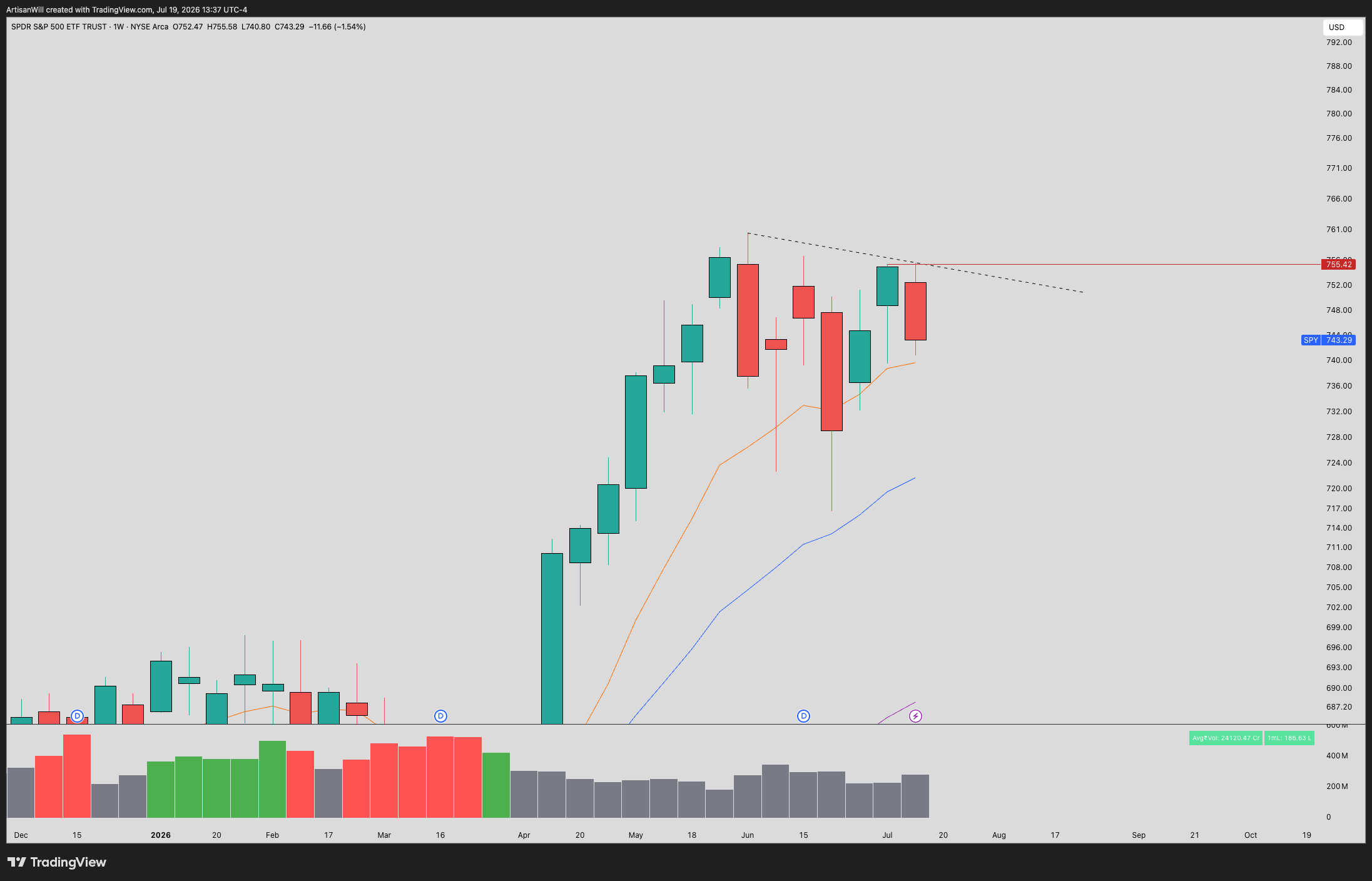
The S&P continues to hold despite the heavy tech selling and taking profit. The ETF is getting propped up through AAPL 0.00%↑, financials and healthcare.
This is now over 7 weeks of price digestion and we are once again at the weekly 9EMA. Assuming buyers continue to step in, we will continue to chop and consolidate. I would not be too concerned until this structure starts to break.
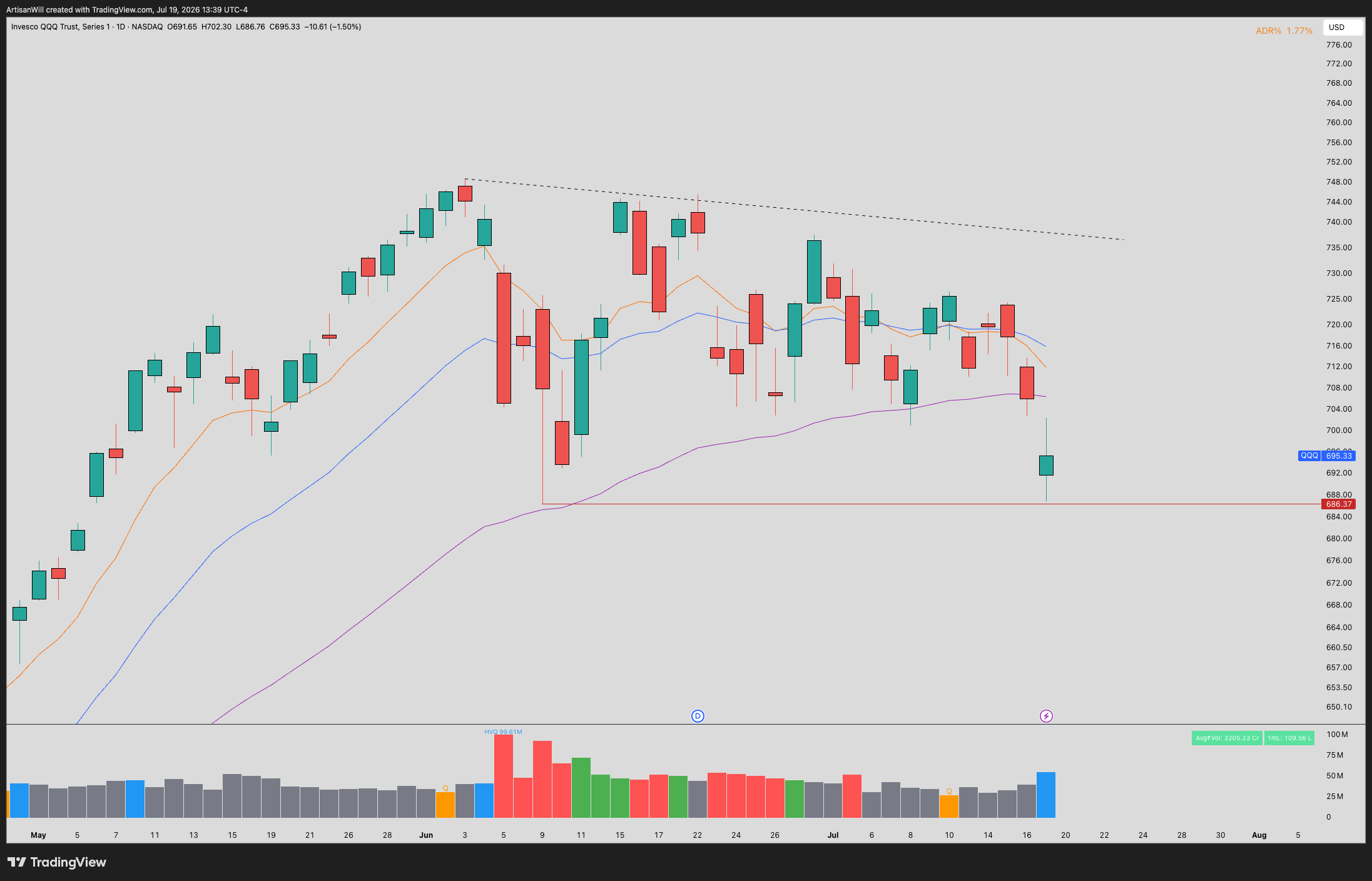
Tech definitely looks a lot uglier than the rest of the market, with heavy profit taking on previous leaders. The one saving grace is that this could be the makings of a double bottom at the lows made on June 9.
There is still a lot work to be done: we either need to see the previous leaders start to act more constructively or new leaders need to emerge.
Until tech starts to lead again, I don’t think a sustained rally in the markets is possible.
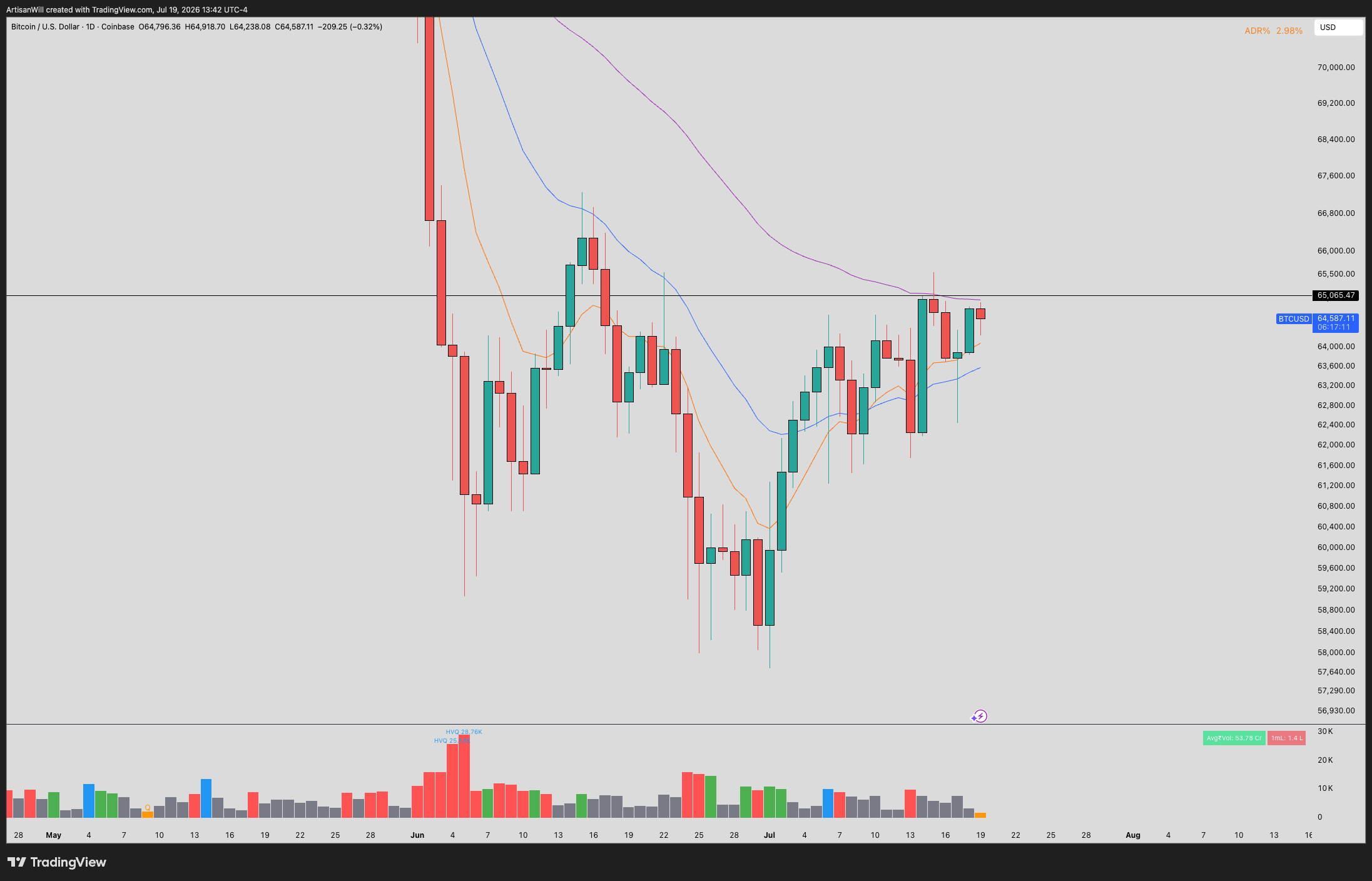
Bitcoin:
Crypto continues to trade against the market! Price is acting constructive here, and trying to reclaim the daily 50EMA.
While there is more work to be done, a reclaim of these levels and taking out that 67k high would be a great start.
If you are a believer in the cycle, this is still the stage of accumulation.
🔍 What I’m Watching
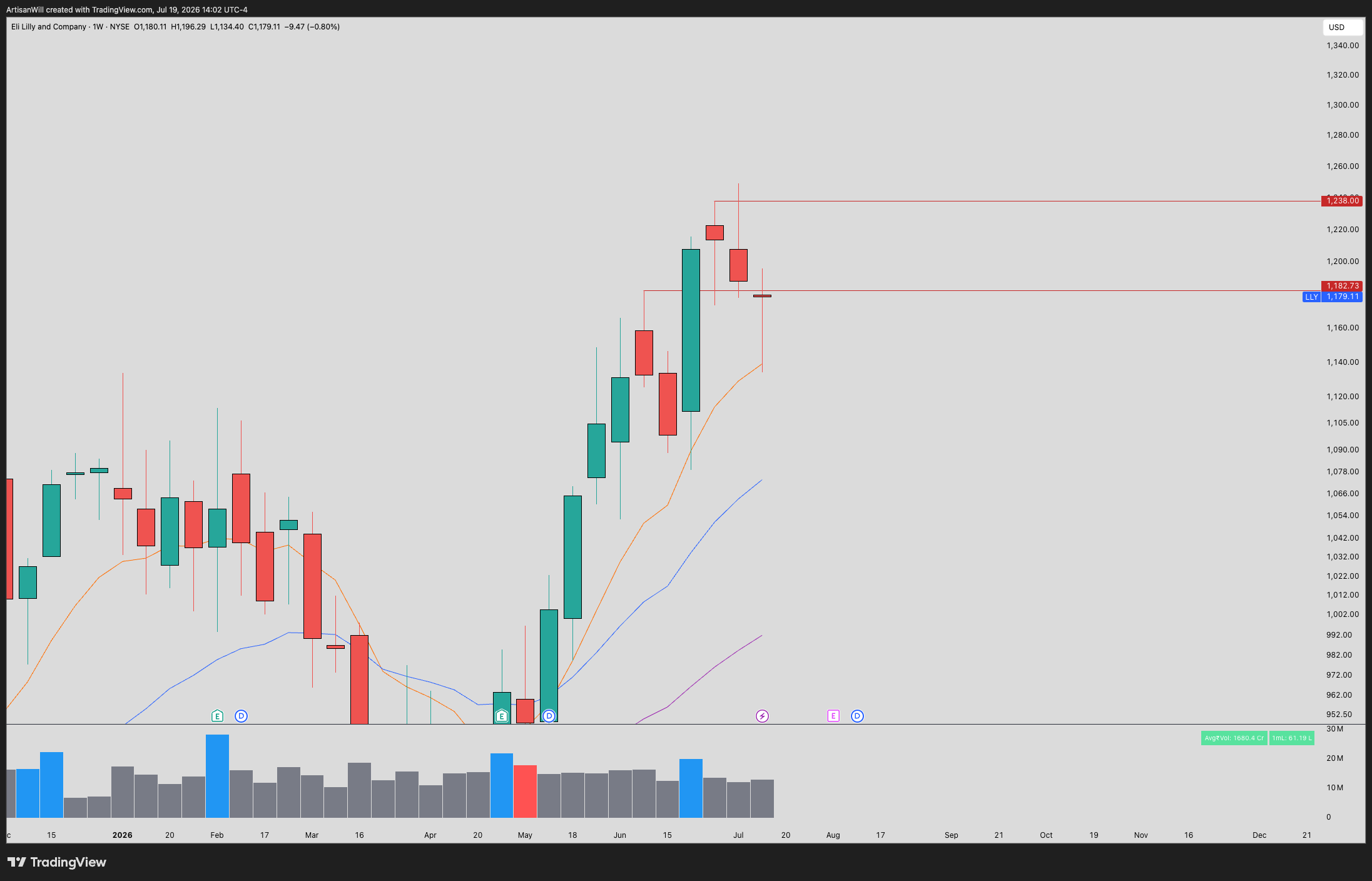
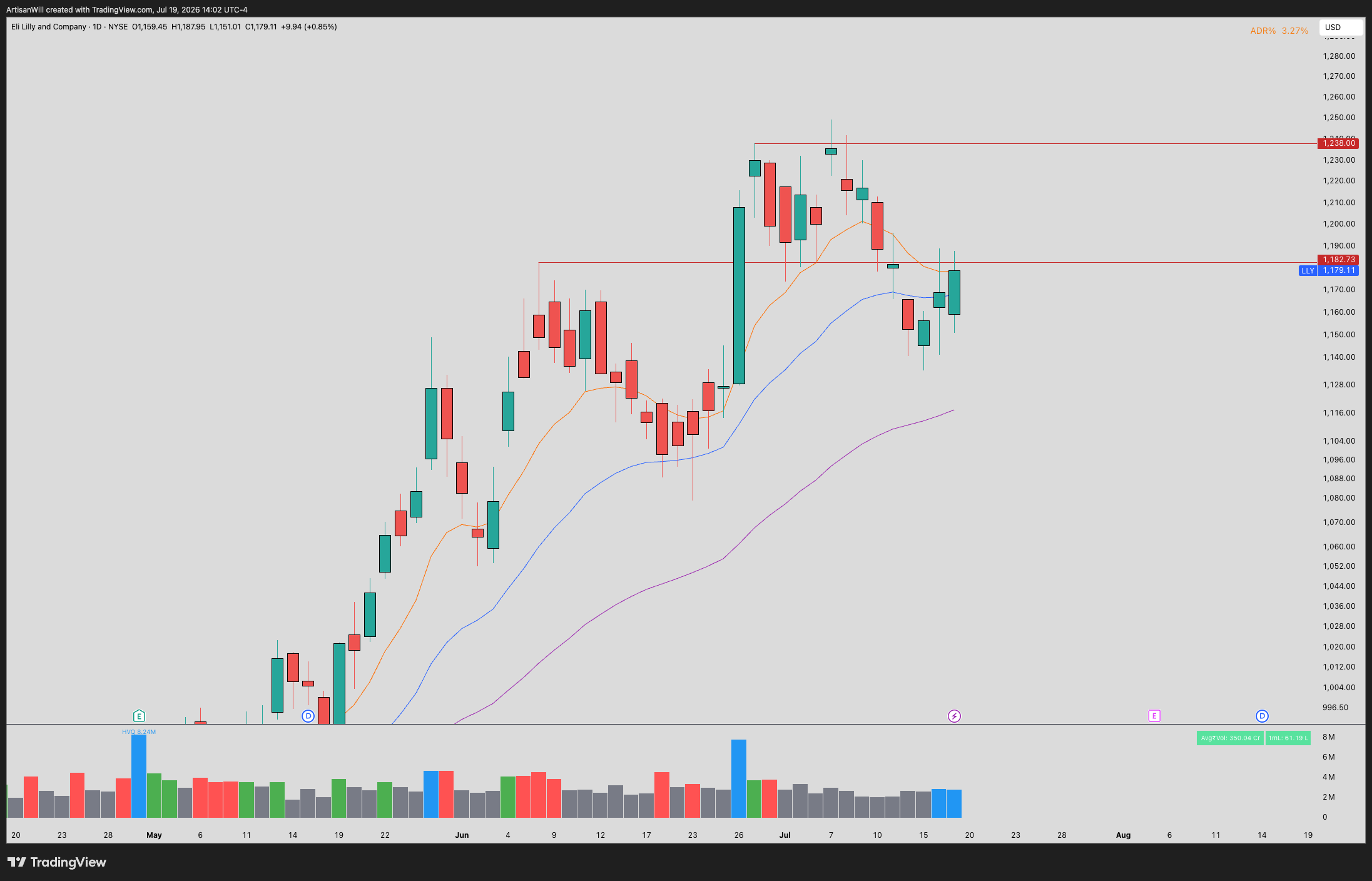
LLY 0.00%↑ - Strong healthcare name compared to its counterparts with a nice weekly 9 tap + daily trying to reclaim previous ATH & daily EMAs
If this reclaim continues, will be looking to trade this earnings run up and target 1238+
Software likely seems to be the focus going into the first half of the week
Despite the tech selling pressure, software is holding up and becoming outliers.
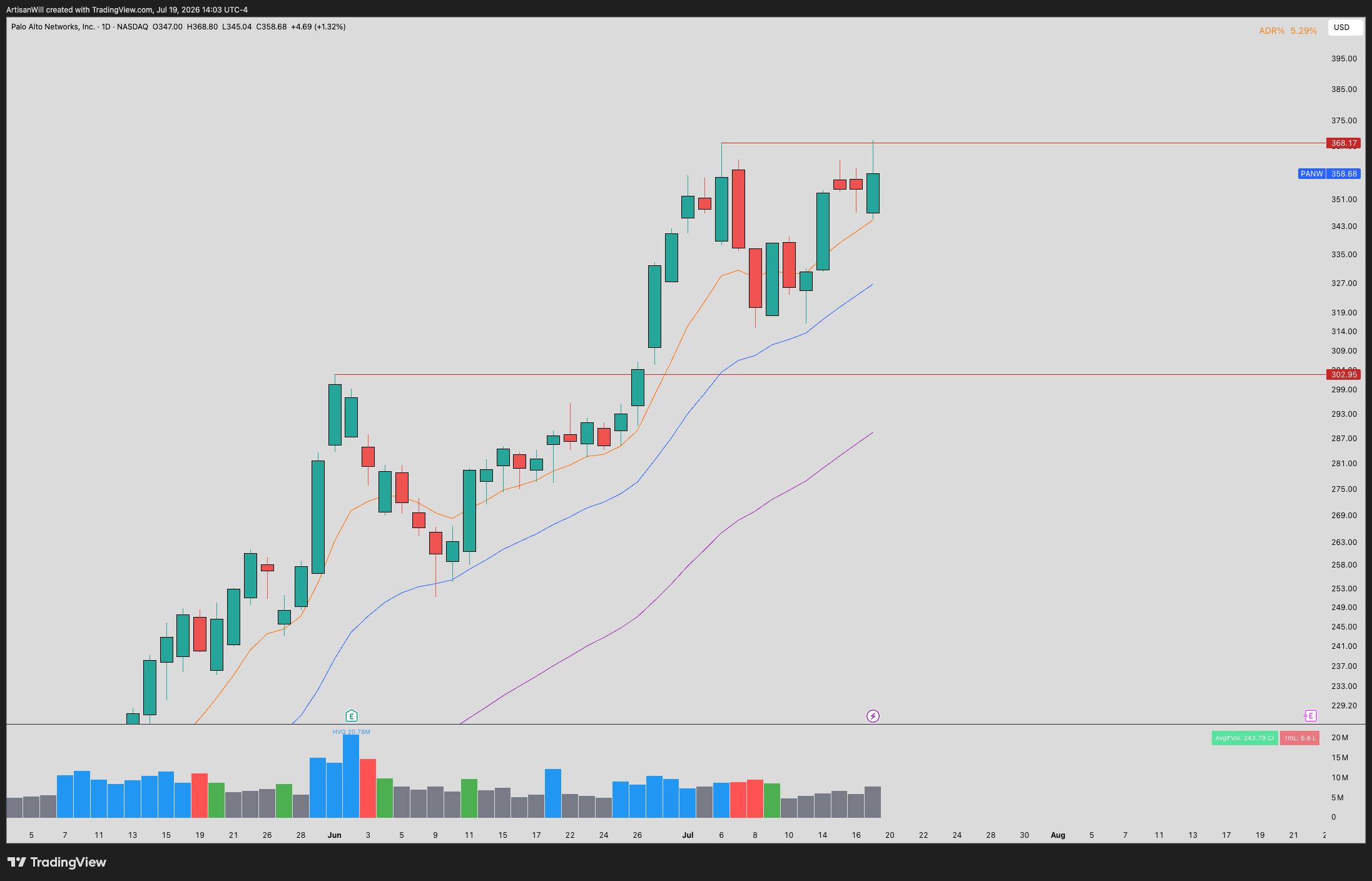
PANW 0.00%↑ had a nice pop Friday with intraday consolidation.
Looking for over this 368 pivot to target 375+
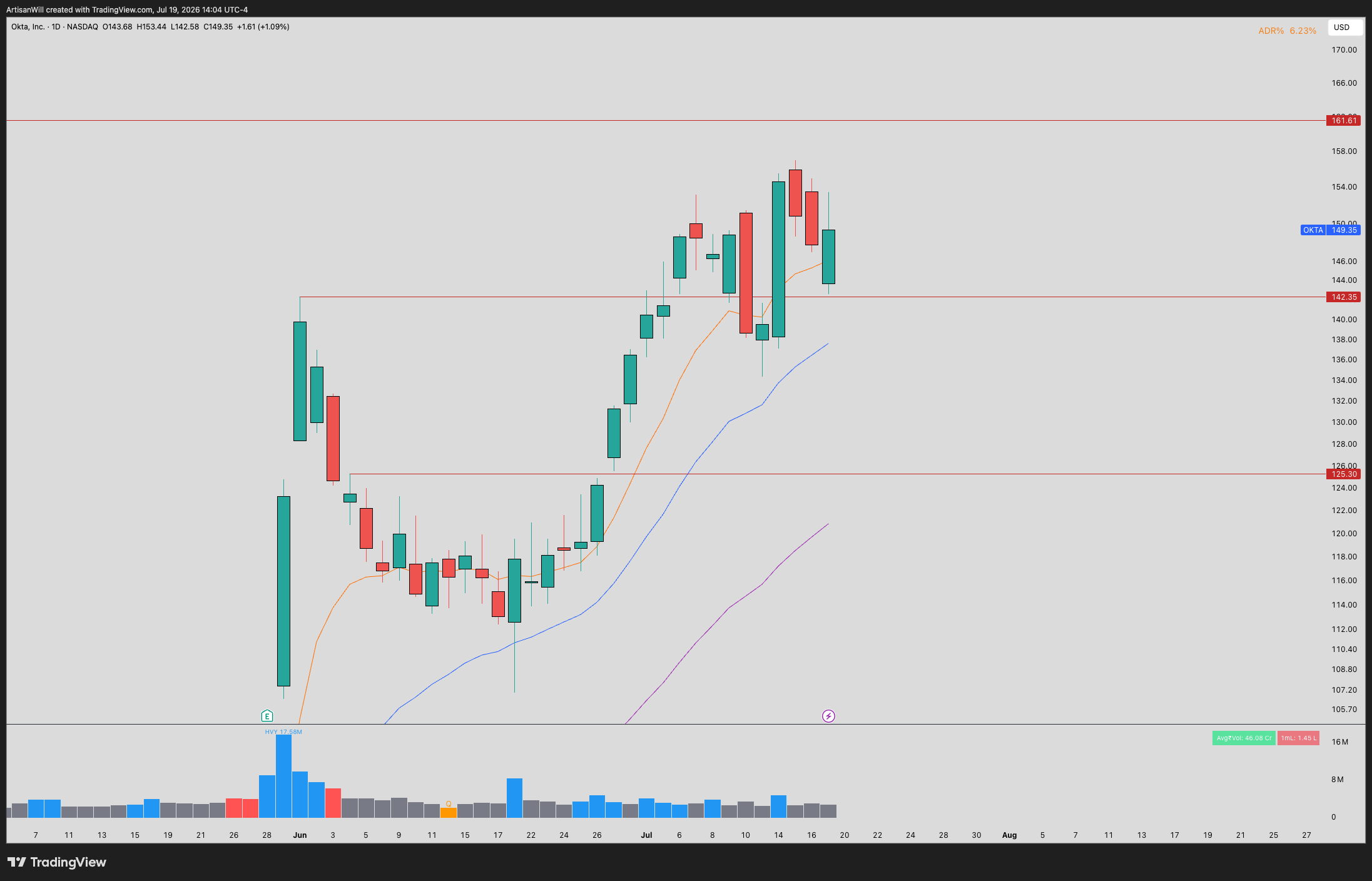
Another software name that has done a low volume backtest of a previous pivot
Could be a great name to add with large cap tech reporting earnings in the next two weeks
Over 161 will be fireworks
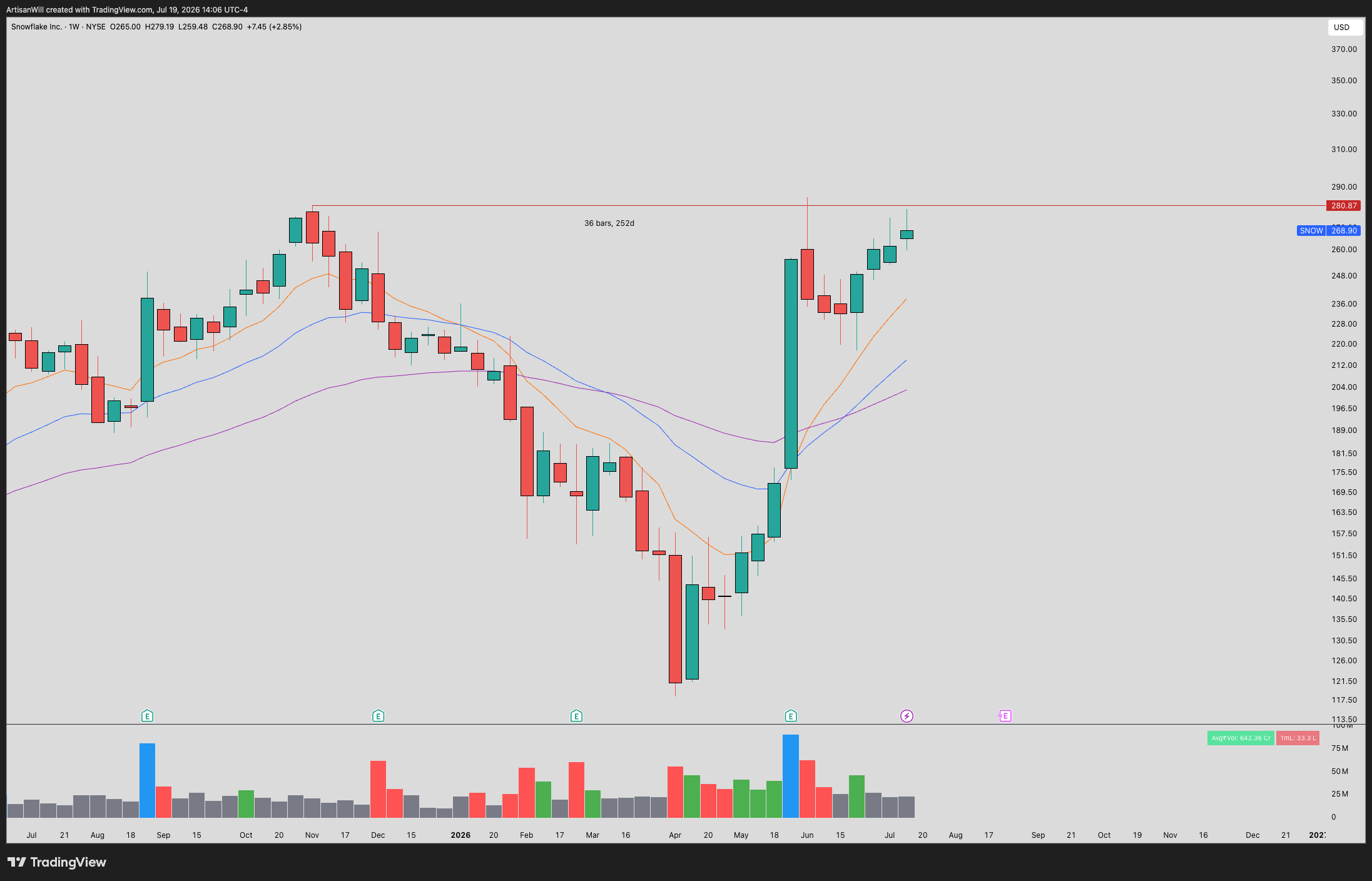
A large weekly base developing under 280 with price drifting upwards riding the daily 9EMA
The best breakout would be a high volume push past 280 instead of the continued slow upward drift.
💡 My Take
I am not trying to catch the semiconductor bottom this week, and I would push back on anyone framing a 20% drawdown as an obvious gift. The honest read is that we do not have the information yet. Buying a bounce on Monday is a bet on a press release. Waiting until Thursday means buying after Alphabet and Intel have actually spoken, at a price that may be higher but with a thesis that is real.
What earns attention is the divergence in last week’s tape. The Russell 2000 lost half a percent while the Nasdaq lost 2.9%, and rates went nowhere. That is not a growth scare or a liquidity event. That is a repricing of one crowded theme. If that holds through this week’s earnings, the rotation trade is more interesting than the dip buying trade, and the cyclical and energy names have a real tailwind with Brent at $88. If it does not hold, if small caps start breaking down too and credit spreads widen, then this was the first leg of something larger and cash is the position.
The setup this week is defined by two binary events I cannot forecast, so the edge is not in predicting them, it is in sizing so that either outcome leaves me able to trade Thursday. Practically: keep size below normal into Wednesday’s close, avoid short dated options through the Alphabet and Tesla prints because implied volatility is already paying for the move you are hoping for, and let Thursday’s reaction to Intel tell you whether last week was information or emotion. The trend from the March lows is still intact. Nothing that happened last week changed that. Respect it, but do not pay for the privilege of being early.
Work with me 1-on-1: I keep a few private spots for traders who want direct help with their process. Details here.
See you next week. Trade well.
Will