
This Week in Markets - April 13: The Ceasefire Rally Meets Earnings Season
Banks kick off Q1 earnings, inflation splits in two, and Wall Street's best week since November gets a reality check.

Welcome back to another weekly market prep with The Dividend Journal! If this is your first time here, great timing. This newsletter is your one stop shop to stay ahead of the market and step into the week fully prepared.
What a week. The market just posted its best performance since November, powered by a ceasefire announcement between the US and Iran that sent stocks ripping and oil plunging. But by the end of the week, the ceasefire was already looking fragile, and a hot headline CPI print reminded everyone that the inflation story isn’t going away.
Now we’re heading into the heart of Q1 earnings season. Every major bank reports this week, ASML gives us a read on the semiconductor cycle, and Netflix closes things out on Thursday. There’s a lot to process.
Let’s get into it.
⚠️ Weekend Update: Talks Collapse, Trump Threatens Hormuz Blockade
Before we get into the week ahead, we need to address what happened today. The US-Iran ceasefire talks in Islamabad ended without a deal. Vance left Pakistan. No agreement, no framework, no next meeting scheduled. These were the highest level negotiations between the two countries since the 1979 Islamic Revolution, and they went nowhere.
It gets worse. Trump immediately threatened a full naval blockade of the Strait of Hormuz, saying the Navy would “immediately” begin interdicting vessels. Iran’s Revolutionary Guard responded that the strait is under their “full control” and any military vessels approaching would get a “forceful response.”
Oil futures are already spiking, with WTI jumping about 7% and Brent rising nearly 6% on the news. The ceasefire expires April 22. The market’s best week since November may be getting a reality check before Monday even opens.
📊 Last Week Recap
This was the week the market finally caught a break.
On Tuesday, the US and Iran agreed to a two-week ceasefire, and the reaction was immediate. The Dow ripped 1,325 points higher, its best single session gain since April 2025. The $SPY shot above the 200 day MA for the first time since mid March, and oil crashed below $95 as the Strait of Hormuz reopening came back on the table. It was a textbook relief rally, hitting hardest in the areas that had been beaten up the most.
But it didn’t last. By midweek, Iran said the ceasefire had been broken, and the rally stalled. Stocks spent the rest of the week digesting the move.
Then came Friday’s CPI report. Headline inflation surged 0.9% month-over-month, the largest single month jump in nearly four years. On an annual basis, CPI hit 3.3%, the highest in two years. Energy was the culprit: the energy index rose 10.9% in March, led by a 21.2% spike in gasoline. The Iran war is showing up in consumer prices now.
Here’s the thing though. Core CPI came in softer than expected. Just 0.2% MoM and 2.6% YoY, both a tenth below forecast. Strip out the energy shock and inflation is actually trending in the right direction. That’s why markets didn’t fall apart on the number. It’s a bifurcated inflation picture: energy is screaming, but underlying demand-driven inflation is cooling.
For the week: the S&P 500 rose 3.6%, its best week since November. The Nasdaq gained roughly 4%. Even with Friday’s slight fade, this was a strong week.
Bitcoin also got a major boost from the ceasefire, surging past $72,000 on Tuesday. It had traded below $68K during the peak of the crisis. Oil and crypto have become increasingly correlated this year, with oil down meaning risk assets up. If the ceasefire holds and crude keeps falling, analysts see a path toward BTC testing $80K.
📅 This Week’s Economic Calendar
Tuesday, April 14: PPI and Core PPI (8:30 AM ET): this is the big one for the week. After that hot headline CPI, Wall Street wants to know if the energy shock is showing up in wholesale prices too. Deutsche Bank expects both headline and core PPI accelerated in March. More importantly, the PPI components feed directly into the core PCE deflator, the Fed’s preferred inflation gauge. So this data is going to shape rate cut expectations heading into May.
Fed Speakers: At least one Fed official is scheduled to speak every single day this week. Notable names include Goolsbee, Barr, Bowman, Williams, and Waller. Expect a lot of commentary around the CPI bifurcation and whether the energy-driven spike changes the rate path.
Earnings this week, courtesy of Earnings Whispers:
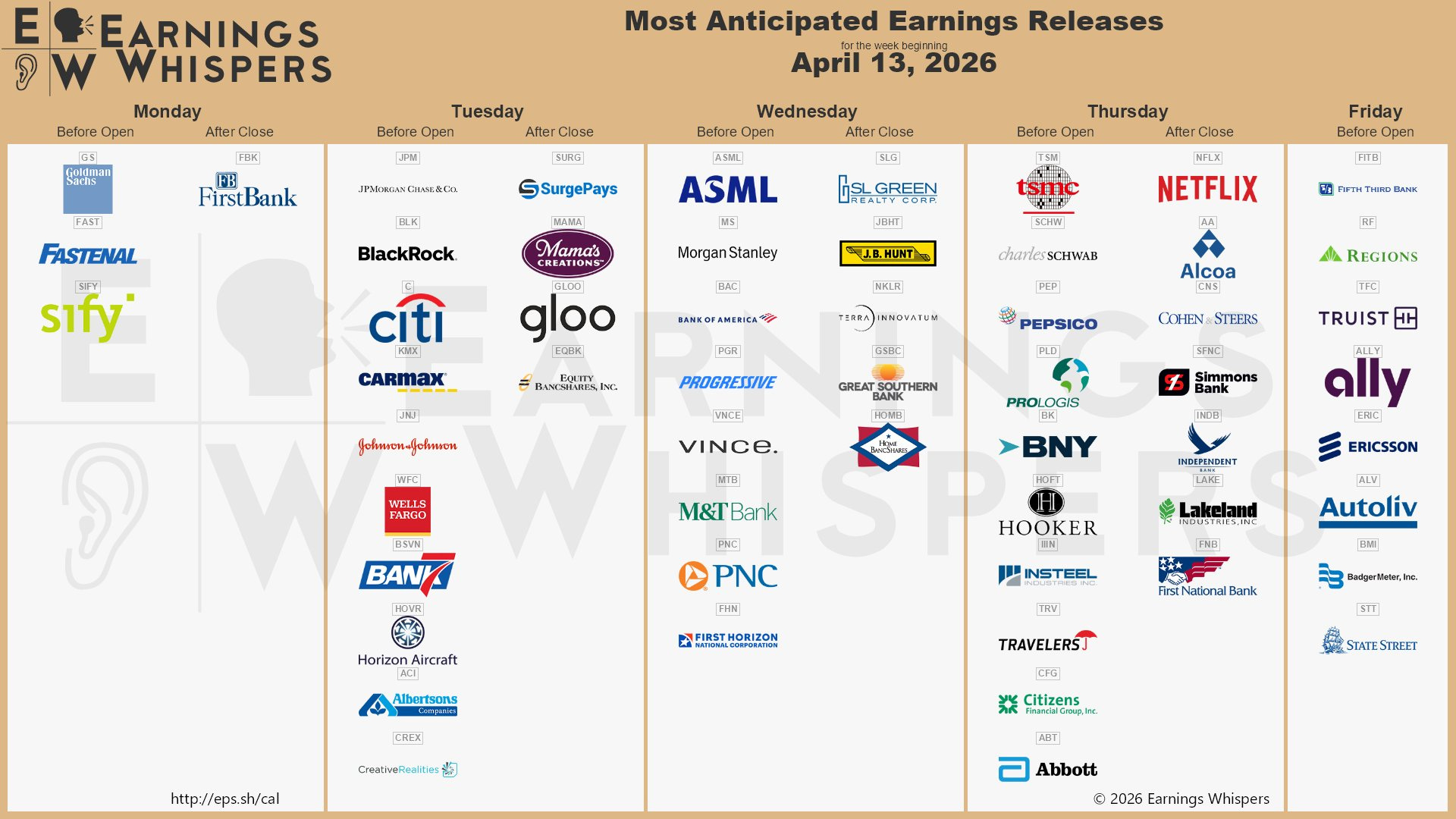
🔥 Big Bank Earnings: The Main Event
This is bank earnings week, and it’s the unofficial start to Q1 2026 earnings season. Every major Wall Street bank reports over a three day stretch, and the commentary from these calls will set the tone for the rest of the quarter.
Here’s the schedule:
Monday 4/13: GS 0.00%↑
Tuesday 4/14: JPM 0.00%↑, C 0.00%↑ , WFC 0.00%↑ , BLK 0.00%↑
Wednesday 4/15: BAC 0.00%↑ , MS 0.00%↑
The big narrative heading in is the M&A revival. After years of drought from 2022 through 2024 when high rates and regulatory uncertainty killed dealmaking, investment banking fees are expected to be the star. Goldman Sachs is expected to report $16.9 billion in revenue (up 12% YoY) with EPS of $16.35 (up 16%). JPMorgan is expected to post EPS of $5.44, up 7% YoY.
But the environment is more complicated than the M&A narrative suggests. The Iran war added volatility to fixed income and commodities trading desks (likely a positive for trading revenue), but it also shook consumer confidence and loan demand. Net interest income growth has plateaued. And credit quality in consumer portfolios, especially anything tied to fuel costs, is worth watching closely.
What to watch for:
Investment banking fees. This is the story. Are pipelines building? Is M&A actually accelerating or just catching up from a backlog?
Trading revenue. Volatility is usually good for trading desks. The oil and rates moves in March should translate to strong FICC numbers.
Credit quality. Any uptick in charge offs or provisions for loan losses? Higher energy prices squeeze consumers.
Forward guidance. What are CEOs saying about the macro? Dimon’s shareholder letter usually gets more attention than the actual earnings.
Bull scenario: Banks deliver strong beats driven by trading and IB fees, guidance stays constructive, and the “earnings are fine” narrative supports the rally. Financials lead.
Bear scenario: Credit cracks show up, CEOs issue cautious forward guidance citing geopolitical uncertainty and consumer stress. The rally stalls and the market realizes earnings growth is narrowing.
